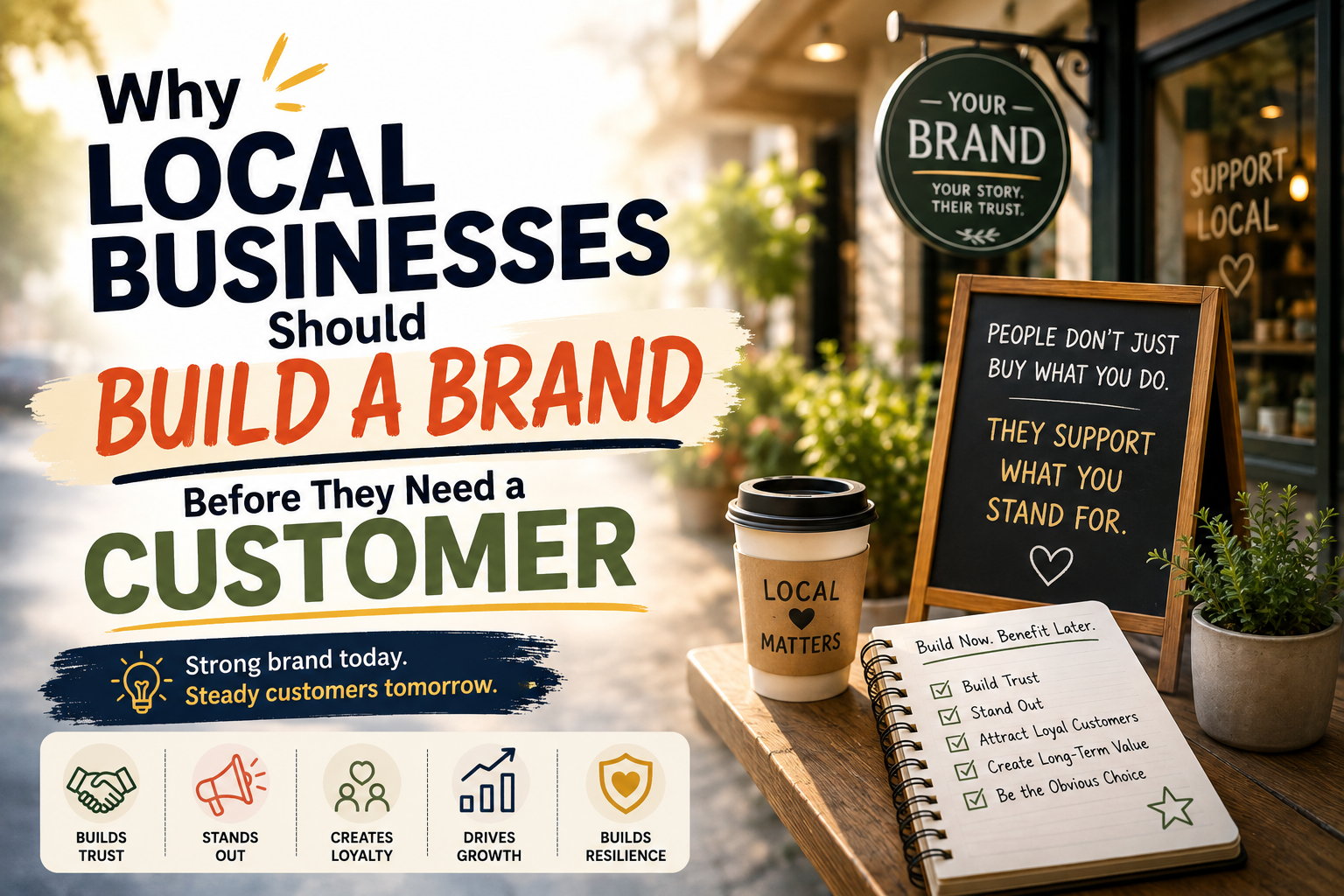
A new local business often feels pressure to get customers quickly. The instinct is understandable: run an ad, offer a discount, hand out coupons, sponsor something, or tell everyone exactly what you sell.
But what if the fastest way to become known in your community isn't to start by asking people to buy?
What if you start by giving?
I've seen this distinction matter again and again in local marketing. People don't simply choose the business that advertises the most. They choose businesses they recognize, understand, feel good about, and trust.
The best way for a new local business to build trust is to become part of the community before asking the community for a transaction. That can mean serving a local organization, supporting a cause you genuinely care about, helping another business, participating in community groups, or simply becoming a good neighbor. When people repeatedly see your business contributing—not just selling—you begin to build familiarity, reputation, and relationships that can eventually lead to referrals and customers.
I call this “serve before you sell.”
And I think it is one of the most practical ideas a new local business can put to work.
Why serving your community can be more powerful than another advertisement
When you're a new business, it's tempting to think your biggest problem is awareness.
But awareness by itself isn't enough.
People can know your business exists and still have no reason to choose you.
Trust is what begins to bridge that gap.
Think about the businesses you personally recommend. There's usually a story behind the recommendation.
Maybe a plumber went above and beyond when you had an emergency. Maybe a local electrician gave you a fair price and did exactly what they promised. Maybe a restaurant owner remembers your name. Maybe a business consistently supports something in your town that matters to you.
Those experiences create something an advertisement can't manufacture overnight: rapport.
In my conversation with a longtime business and community expert on Be Locally Loved, we talked about exactly this. His advice was simple: if you're new to a community, get entrenched in it.
Don't just show up to sell.
Show up to participate.
Want the short version?
I pulled the heart of this conversation into a short, TED Talk-style video so you can get the central lesson quickly.
▶ Watch the Short Talk: [Short Talk Video Link]
What does “serve before you sell” actually mean?
When I talk about serve before you sell, I mean building relationships and demonstrating your values before making the relationship primarily about a transaction.
That doesn't mean you shouldn't market your business.
It doesn't mean you should give away your services indefinitely.
And it certainly doesn't mean you can't ask for the sale.
It means the sale isn't the only reason you're showing up.
For a new local business, that could look like finding a nonprofit that genuinely matters to you and volunteering your expertise. A landscaper might donate landscaping services to a local charity. A contractor might help with a community project. A business owner might support a food pantry, animal organization, school initiative, chamber, or local business association.
The important part is that the service is authentic.
Community involvement works best when it reflects something the business owner actually cares about.
That authenticity matters because people can usually tell the difference between genuine involvement and a marketing stunt.
And when you do something valuable for a community organization, there's another natural benefit: the organization may talk about the work, share photos, introduce you to other people, or simply remember you when someone asks, “Do you know somebody who can help with this?”
That's how word of mouth begins.
How can a new local business get its name out without a huge advertising budget?
Start by looking for places where you can contribute something meaningful—not just places where you can put your logo.
This is especially useful for businesses that are new, bootstrapped, or don't have a large marketing budget.
One of the examples I shared in our conversation came from a landscaper. Instead of simply advertising landscaping services, I suggested finding a charity where he could actually use his skills, doing the landscaping, and gifting the work.
Now something different can happen.
The charity can photograph the project. They can share what happened. People can see the business doing something generous. The business owner becomes associated with service rather than simply promotion.
That is a very different first impression.
And first impressions matter.
Look for community organizations where your skills are genuinely useful
Don't volunteer randomly just because you think it might generate leads.
Ask:
What do I care about?
What organizations are doing meaningful work here?
What can my business actually contribute?
Where can I make someone's job easier?
What community need connects naturally with my values?
That might lead you to a school, food pantry, animal rescue, nonprofit, chamber of commerce, business association, neighborhood organization, or another local cause.
The goal isn't to manufacture a marketing opportunity.
The goal is to become useful.
The marketing benefit comes naturally from being useful.
Why should community involvement be part of your website?
Here's one thing I wish more local businesses would do: tell people about the things you care about.
Your website probably has an About page.
You probably have a Services page.
You may have testimonials, contact information, photos, FAQs, and information about your products.
But where do I learn what you believe?
Where do I learn what matters to you outside of making money?
Where do I see how you're connected to the community?
That information can help humanize your business.
A prospective customer might be comparing three plumbers who all offer similar services. Their websites may look almost identical.
Then one of them has a page that says, essentially:
“Here's what we believe. Here's what matters to us. Here's how we're involved in our community.”
That gives me another reason to connect.
Your community involvement can become a trust signal because it gives people another way to understand the humans behind the business.
And in a world where so much business communication is becoming automated, templated, and increasingly influenced by AI, that human element matters.
People want to know the person behind the business
I often talk about the importance of being known, liked, and trusted.
But I think there's another layer underneath those words: connection.
We're surrounded by digital communication, automated systems, generated content, ads, messages, and technology.
That makes genuine human connection more valuable—not less.
During our conversation, we talked about a simple example involving a food-delivery robot. The machine reaches a crosswalk and waits because it needs a human to push the button.
The point wasn't really about the technology.
It was about what the example represents: even with technology, we still need humans.
That idea applies directly to local business.
A local business has an opportunity that a faceless transaction often doesn't: to become part of someone's actual community.
You can know your neighbors.
You can support local organizations.
You can refer business to another local business.
You can show up when something needs to be done.
You can become the person people think of when someone asks, “Who do you recommend?”
That's a much stronger position than simply hoping someone clicks an ad.
How can local businesses become more connected to their communities?
Start by becoming neighborly—not only as a person, but as a business.
One of the examples shared in our conversation involved a community where local businesses actively referred customers to one another.
A med spa might have information about a flower shop.
The flower shop might have brochures for a frame shop.
A customer might walk into one business looking for something they don't offer, and instead of saying, “We don't do that,” the owner says, “Go see Joe down the street.”
That is neighborly business.
And it creates a network where businesses help one another succeed.
The same principle applies to community organizations.
A garden club might beautify downtown.
Local businesses support the garden club.
The community benefits from a more beautiful downtown.
People visit those businesses.
The businesses support the organizations again.
The cycle continues.
Nobody is operating in isolation.
A thriving local business ecosystem is built when businesses, residents, organizations, and community groups recognize that their success is connected.
That's the kind of local marketing I love.
Why community involvement can strengthen your brand
A brand isn't just a logo, color palette, tagline, or website.
Your brand is also the story people associate with you.
What do you stand for?
How do you behave?
How do you treat people?
What do you contribute?
Who do you support?
What do people say about you when you're not in the room?
Those things become part of your reputation.
I've spent decades working in marketing and media, and one thing I've learned is that visibility is much more valuable when it is connected to credibility.
You don't just want people to see your name.
You want them to see why they should trust your name.
That's part of the reason I built Be Locally Loved around the idea of helping local businesses become more visible, credible, trusted, remembered, and chosen.
It's also part of what I love about BeLocal.
We're not simply trying to create another coupon or “50% off your first visit” message.
We're creating a first impression and helping local businesses become recognized as part of the community.
How I think about connection, community, and Be Local
When I was building BeLocal Georgetown, I was thinking about more than marketing.
Georgetown was growing quickly, and I knew that growth was going to change the community.
I couldn't stop the growth.
But I could contribute to how we welcomed people into it.
My goal was to help pass along the history, heart, and culture of Georgetown to people who were new to town—to invite them into the community rather than leaving them on the outside of it.
That is still deeply connected to how I think about local marketing.
A publication, a business, a community organization, or a local entrepreneur can become a connector.
It can introduce people.
It can create familiarity.
It can make a new resident feel like they know where to go, who to trust, and how to participate.
That's why I believe local marketing is about so much more than advertising.
The strongest local brands don't just ask, “How can we get customers?” They also ask, “How can we contribute to the place where those customers live?”
What should a new local business do first?
If you're new to a community and you're trying to build your name, I wouldn't start by asking, “Where can I buy the cheapest ad?”
I'd start with these questions.
1. Find something you genuinely care about
Choose a cause, organization, or community need that means something to you.
Your involvement will be much more sustainable when it isn't manufactured for marketing.
2. Use your actual business skills
Don't assume community service has to mean writing a check.
A landscaper can landscape.
A photographer can provide photography.
A designer can help with creative work.
A contractor can contribute skilled labor.
Think about what you're uniquely equipped to give.
3. Get involved before you need something
Join the chamber. Participate in a business association. Attend community events. Get to know other business owners.
Don't wait until you need referrals to start building relationships.
4. Tell your story on your website
Give people a place to learn what matters to you.
Your community involvement can be part of your brand story, not hidden somewhere nobody will find it.
5. Let people discover what you do naturally
You don't have to turn every conversation into a sales pitch.
When you're involved, people will eventually ask what you do.
That's a much more natural opening for a business conversation.
6. Keep showing up
Trust isn't usually created by one event.
It's built through consistency.
Show up. Contribute. Help. Refer. Participate. Repeat.
Over time, people begin to recognize you as part of the fabric of the community.
Key Takeaways
Serve before you sell. Build relationships and demonstrate your values before making every interaction about a transaction.
Use your skills to give back. Your professional expertise may be more valuable to a nonprofit or community organization than a simple donation.
Make your values visible. Your website should give people a chance to understand the person and beliefs behind the business.
Become neighborly in business. Referring customers to other local businesses can strengthen the entire local ecosystem.
Connection creates trust. People want to do business with people they know, like, and trust.
Keep showing up. Community reputation develops through consistent participation, not one promotional event.
Think beyond customer acquisition. A local business can help build the community it depends on.
Common Questions About Building Trust as a Local Business
Is community involvement really a form of marketing?
Yes, but I wouldn't treat it as a traditional advertising tactic. Community involvement can help people become familiar with your business and understand what you value. The distinction is that you're contributing first rather than asking for a transaction first. When that involvement is genuine, it can naturally create conversations, referrals, recognition, and trust.
What if my business doesn't have much money to spend on marketing?
Start with what you already have: your time, skills, relationships, and willingness to help. A new business doesn't necessarily need a large advertising budget to begin becoming known. Find a community need that connects with your expertise and contribute something useful. The goal is to create a meaningful first impression, not simply to put your logo everywhere.
Should I put my community involvement on my website?
Absolutely. If community involvement is genuinely part of who you are, your website should give people a way to see it. Include your beliefs, causes, community work, or other meaningful commitments in a way that feels natural. It gives prospective customers another reason to understand and connect with the people behind your business.
How long does it take to build trust in a local community?
There isn't a specific timeline. Trust develops through repeated experiences and consistent behavior. That's why I believe local businesses should think about visibility as an ongoing effort rather than a single campaign. You want to be present and contributing before the exact moment someone needs your service.
Why I Believe Connection Is the Real Local Advantage
The more I work in local marketing and media, the more convinced I am that connection is one of the things technology can't replace.
AI can help us communicate faster.
Technology can help us automate.
Digital tools can help us reach more people.
But none of those things changes the basic human desire to know who we're doing business with.
When a local business owner becomes part of the community—when they serve, participate, refer, help, and show people what they genuinely care about—they become more than a business.
They become a neighbor.
And that's a powerful thing.
I've always believed that good businesses deserve to be seen, trusted, remembered, and chosen. But I also believe something bigger happens when those businesses use their visibility to strengthen the communities around them.
Sometimes the best marketing strategy is simply to become the kind of business people are happy to recommend.
Serve first. Get connected. Be neighborly. Then let the relationships do what relationships do.
Want to hear the full conversation?
The short talk gives you the central lesson, but our longer Be Locally Loved conversation goes deeper into the ideas behind community connection, reputation, business relationships, and what it really means for a local business to become part of the place it serves.
▶ Watch the Full Be Locally Loved Conversation:
🎧 Listen to the Full Be Locally Loved Conversation: https://open.spotify.com/episode/6hq4AuFwqWQnrwjx0foBX6?si=-rrTBnAxRQ6W5UZnTQmIsA